
World Heritage Test Grade 2 Difficulty in Japan | Self-Study 8-Week Plan
The World Heritage Test Grade 2 is best approached as an entry into intermediate territory rather than a simple step up from the beginner level. The difficulty comes less from the depth of any single topic and more from the breadth of covering all 26 Japanese World Heritage sites and 300 major world sites, plus the need to stay current with registration updates.
That said, self-study is entirely viable. This article walks through a realistic 8-week study sequence built around the official textbook, learning-assist videos, and official past-question collections. We also cover the differences between venue-based and CBT testing, how to approach the question scope, and everything you need to prepare with confidence.
How Difficult Is Grade 2? Starting with the Bottom Line
The World Heritage Test Grade 2 occupies an "intermediate entry" position. While Grade 3 focuses on roughly 100 representative sites, Grade 2 expands to all 26 Japanese sites and 300 representative world sites, so the study load stems from sheer volume and the need to track current developments.
The difficulty is not about tricky questions. The wall comes from breadth and the need to connect information. Memorizing site names paired with country names is not enough. You need to know whether a site is cultural or natural, which registration criteria apply, and how similar-theme sites differ. Those who organize knowledge by theme, such as "cultural landscapes," "religious architecture," "earth history," tend to score more consistently.
Another factor: World Heritage is a continuously updating field. After the 47th World Heritage Committee in 2025, the total stands at 1,248 sites. The official Grade 2 textbook reflects information through the 2024 committee session. Studying "once and done" risks missing recent changes, and pure memorization without understanding registration context becomes brittle when questions shift angle.
Difficult, but Self-Study Works
Despite intermediate-level difficulty, the study path is straightforward. The official Grade 2 overview provides clear scope and learning points, with the official textbook, past-question collection, and learning-assist videos forming a complete resource set. Material selection is not confusing, making self-study practical.
The strongest approach is securing scoring foundations first rather than trying to memorize everything uniformly. Prioritize: World Heritage system basics, all Japanese sites, and high-frequency themes like registration criteria and cultural/natural characteristics. For Japanese sites, learning not just names but the specific values that earned registration stabilizes memory.

【2級】概要と例題・対策
www.sekaken.jpGrade 2 Difficulty Is About Organization, Not Depth
While studying, you may panic about how many unknown sites remain. In reality, you do not need encyclopedia-level detail on each one. What you need is the ability to organize and connect information. Bundling sites by themes like "Gothic architecture," "Islamic architecture," "ancient Roman heritage," "pilgrimage routes," "industrial heritage," "cultural landscapes," and "earth history" transforms isolated memorization into coherent clusters.
💡 Tip
Those who improve fastest at Grade 2 are not those who chase site names but those who can briefly explain "why was this site registered." Being able to state the registration reason in one sentence naturally links country, classification, and features.
For the Fastest Path to the Passing Line, Sequence and Repetition Matter
Efficient study means fixing your sequence and repeating, not adding more materials. Start with official materials for the overview, solve questions, then return to the textbook for missed areas. This back-and-forth is the strongest approach. Grade 2's broad scope means attempting to memorize perfectly in one pass is less effective than multiple cycles that gradually fill knowledge gaps.
Exam Overview | Question Scope, Pass Criteria, and Testing Methods
Question Scope and Key Themes
The official name is World Heritage Test. Grade 2 represents the stage of "broadly and systematically covering World Heritage," with the scope centered on all 26 Japanese sites and 300 major world sites. The jump from Grade 3's 100 sites is where most people first feel the increased workload.
The 2025 textbook edition covers all 26 Japanese sites registered as of March 2025 and 300 representative world sites. Japanese sites are limited in number, so organizing them including registration criteria directly boosts scores. For the 300 world sites, a regional-only approach scatters memory; bundling by themes like cultural landscapes, religious architecture, ancient civilizations, industrial heritage, and earth history aids retention.
For context, the total number of World Heritage sites stands at 1,248 across 169 countries and territories after the 47th Committee session. Grade 2 does not test all of these, but understanding the scale of the system deepens comprehension.
Grade 2 rewards organizing around why each site was valued rather than memorizing names in isolation.
Pass Criteria and Scoring
The exam is administered on a 100-point scale. While "60 out of 100 as a guideline" is commonly cited, the exact passing score can vary by session. Plan your study around "consistently exceeding approximately 60 points," but confirm the specific threshold in each session's official announcement.
Venue-Based vs. CBT Testing
Grade 2 offers both venue-based testing and CBT testing. The most important point: there is no difference in difficulty or certification value between the two. The distinction is purely logistical.
Venue-based testing uses paper answer sheets on fixed dates at designated locations. CBT allows choosing date and time during the testing window at approximately 350 test centers nationwide. CBT also permits schedule changes up to 4 days before the exam date.
| Item | Venue-Based | CBT |
|---|---|---|
| Format | Paper mark sheet | Computer-based |
| Schedule | Fixed dates | Choose within testing window |
| Locations | Designated venues | ~350 test centers nationwide |
| Changes | Not publicly stated | Up to 4 days before |
| Difficulty/Certification | Same | Same |
Choose based on convenience, not capability. If you want a fixed deadline to focus toward, choose venue-based. If you need scheduling flexibility, choose CBT.
Why Grade 2 Feels Difficult
Background Knowledge Creates Score Gaps
A major stumbling block is that world history and geography background dramatically changes how information "clicks." Reacting instantly to region names like "Mesopotamia," "Andes," "Maghreb," or "Balkans" makes connecting sites to locations and contexts much easier. Without that framework, site names float without anchors.
Grade 2 cannot be mastered through name memorization alone. Basic knowledge of civilization history and physical geography allows educated guesses even for unfamiliar sites.
The 300-Site Memorization Wall and the Need for Association
The 300 representative world sites require learning not just names but locations, features, and the values that earned registration. Sequential flashcard-style cramming breaks down when similar names, heavily religious regions, and concentrated ancient-city areas create confusion.
The solution is association by theme. "Gothic architecture," "Islamic architecture," "ancient Rome," "pilgrimage," "industrial heritage," "cultural landscapes," "earth history," "biodiversity" as organizing axes stabilize memory far better than country-by-country lists.
ℹ️ Note
Grade 2 memorization gets dramatically easier when you shift from "eliminating sites one by one" to "being able to explain the differences between similar sites."
Registration Criteria and Thematic Understanding
Grade 2 demands understanding of the World Heritage system itself. Cultural, natural, and mixed heritage classifications exist, along with theme-specific concepts like cultural landscapes. Without this framework, "knowing the facts but not being able to answer" becomes a real problem.
Registration criteria are particularly tricky. Whether a site was evaluated for architectural merit, landscape value, geological significance, or ecosystem importance affects what you need to study. The same "cultural heritage" label covers sites valued for very different reasons.
Japanese Sites: Memorize Registration Criteria as a Set
Japanese sites are limited in number, so memorization gaps are conspicuous. Names alone are insufficient for Grade 2; you need to pair each site with which values earned its registration. Group Japanese sites by themes like faith, industry, natural landscape, and cultural exchange to create connections that extend naturally into world-site study.
Keeping Up with the Latest Committee Developments
World Heritage is a living system. The World Heritage Committee handles new registrations, name changes, Danger List additions and removals, and delistings. This time-sensitive element distinguishes the exam from pure historical memorization.
Focus on understanding how committee decisions work and which major developments occurred recently, rather than tracking every news item. Awareness that the system continues to evolve prepares you for questions about recent changes.
Self-Study Methods | Material Usage and Study Sequence
The Standard Sequence: Official Textbook, Videos, Past Questions
The least confusing sequence is official textbook, learning-assist videos, official past-question collection. Each serves a distinct role: textbook for knowledge input, videos for overview and connections, past questions for question-format familiarity. This order prevents the disconnect between "read but cannot remember" and "solving questions but cannot understand explanations."
Theme-Based Understanding
Organizing sites by theme is far more efficient than memorizing them individually. Group by "religious architecture," "ancient civilizations," "trade routes," "pilgrimage," "industrial heritage," "cultural landscapes," "earth history," "biodiversity." Country-based reading stacks knowledge vertically; theme-based grouping creates horizontal connections.
A self-made cross-reference chart mapping geography, era, registration criteria, and keywords onto a single page dramatically improves retention.
Fix Japanese Sites First
Start with basics and Japanese sites before diving into the world's 300. Japanese sites offer a clear, bounded scope where registration-criteria knowledge directly translates to points. Organizing them by theme (faith, industry, natural landscape, cultural exchange) creates a bridge to world-site study.
Past-Question Cycling: Error Analysis, Re-Reading, Re-Practice
Past questions work best as early diagnostic tools, not end-of-study confirmations. After solving, classify errors: "unknown site," "confused region," "wrong era," "vague registration criteria." Return to the textbook for missed areas, then re-attempt. This spiral builds connected knowledge.
8-Week Study Schedule
Standard 8-Week Plan
Week 1-2: Overview. Skim the textbook and watch learning-assist videos. Goal: explain the difference between cultural/natural/mixed heritage, registration criteria concepts, and the exam's Japan vs. world weighting.
Week 3: Foundation strengthening. Deepen registration criteria, World Heritage Convention concepts, Danger List mechanics, and evaluation frameworks.
Week 4: Japanese site reinforcement. Organize all 26 Japanese sites by name, location, classification, evaluation points, and keywords. Use thematic grouping.
Week 5-6: World 300-site theme organization. Bundle by "religious cities," "pilgrimage routes," "ancient civilizations," "fortress cities," "trade routes," "colonial cities," "industrial heritage," "cultural landscapes," "volcanoes," "glaciers," "marine," "biodiversity."
Week 7: Past-question intensive. Classify errors by theme, return to textbook for weak areas, complete the error-analysis-to-re-read-to-re-solve cycle.
Week 8: Weak-point reinforcement and current-events check. Tighten remaining gaps, confirm recent committee developments, run final timed practice.
4-Week Speed Plan
For those with Grade 3 background or existing knowledge, 4 weeks is feasible. This plan reorganizes existing knowledge into Grade 2 format rather than building from scratch.
Week 1: Compressed overview plus Japanese sites. Week 2: Foundation reinforcement plus Japanese site completion, world-site theme headers. Week 3: World 300-site theme organization at speed. Week 4: Past questions, weak-point reinforcement, current-events confirmation.
💡 Tip
The most common 4-week failure is reading world sites country by country. Short-term plans benefit from theme-based bundling.
Weekday/Weekend Time Allocation and Progress Checks
Fixing study slots works better than studying "when free." Example weekday rotation: Monday = videos/textbook, Tuesday = Japanese sites, Wednesday = foundation knowledge, Thursday = world-site themes, Friday = weekly review. Weekends: one day for textbook re-reading and note organization, one day for past questions and confirmation tests.
Weekly checkpoints by phase: Weeks 1-2, "Can I explain the overview?" Weeks 3-4, "Can I state Japanese sites and basics?" Weeks 5-6, "Can I group the 300 world sites by theme?" Week 7, "Can I classify my errors?" Week 8, "Are my weak points narrowed?"
Recommended Materials and Free Tools
Official Textbook
Fix your first book as the official Grade 2 textbook. It covers the 26 Japanese sites and 300 representative world sites as of March 2025, reflecting information through the 2024 committee session. Use it as a multi-pass resource (first pass for the map, second for Japanese sites and basics, third for thematic world-site organization) rather than a one-time read.
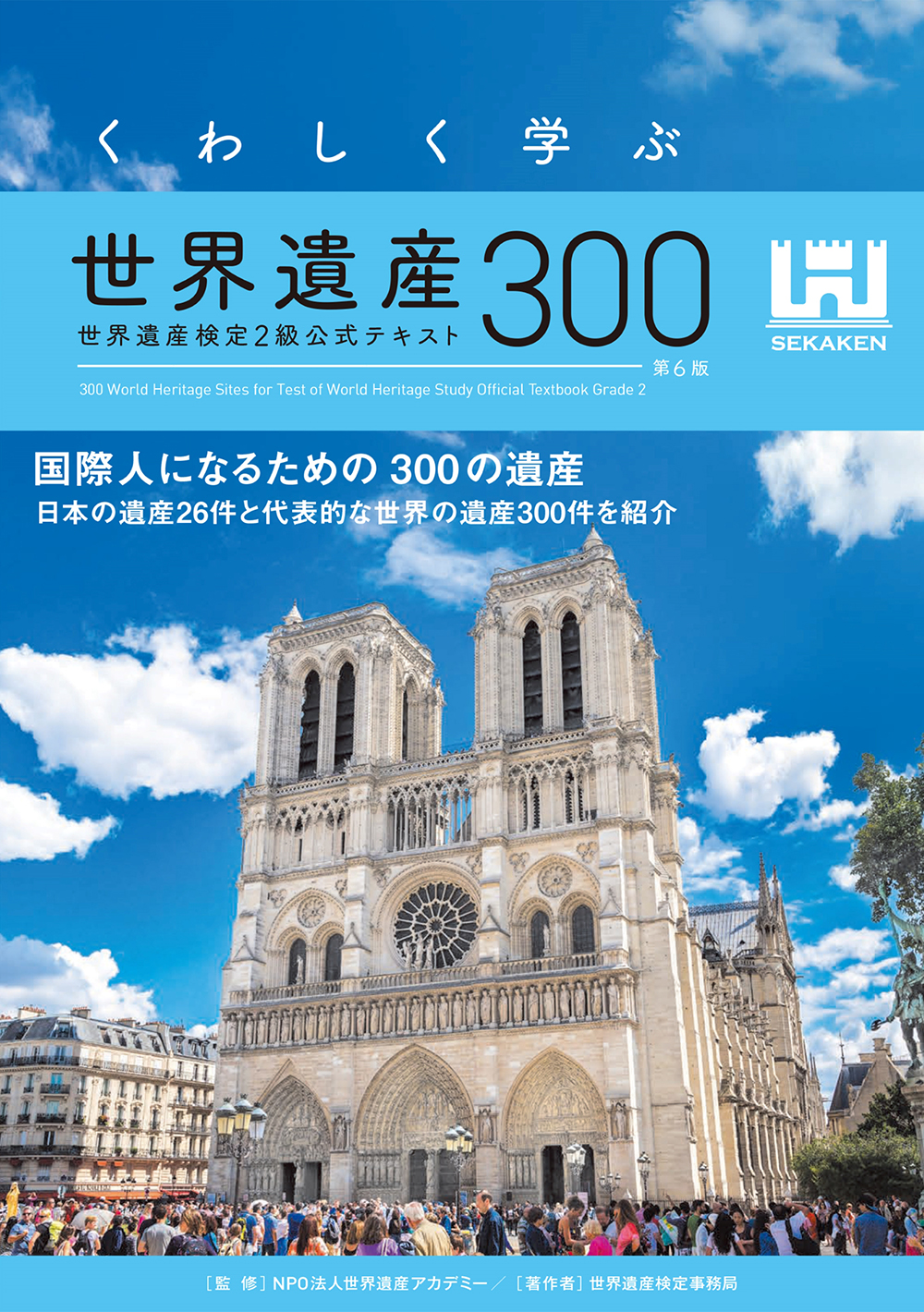
2級テキスト
www.sekaken.jpOfficial Past-Question Collection
The 2026 edition includes three Grade 2 exam sets from 2025. Use past questions early as diagnostic tools, not just final-stage score checks.
ℹ️ Note
Cycle past questions as: 1st pass for reality check, 2nd pass for topic confirmation, 3rd pass for error prevention.
問題集
www.sekaken.jpLearning-Assist Videos
Official videos include introduction, basic knowledge, Japanese heritage, and world heritage segments totaling approximately 113 minutes, plus a front/back split of approximately 60 minutes. Combined, roughly 173 minutes of content. Best used at the start of study and when mid-study knowledge becomes scattered.
Free Tools: Quizzes and Research Blog
Official-site quizzes maintain exposure frequency on days when full study sessions are impractical. The research blog helps capture current-events context, preventing knowledge from becoming stale.
Material Role Comparison
| Material | Primary Role | Best Study Phase | Strength |
|---|---|---|---|
| Official Grade 2 Textbook | Knowledge input | Start through mid-study | Systematically covers the exam's core scope |
| Official Past-Question Collection | Trend analysis, practical exercise | Mid-study through pre-exam | Reveals question patterns and weak points |
| Learning-Assist Videos | Overview, study-method understanding | Study start and review milestones | Quick orientation in short time |
| Free tools (quizzes, blog) | Repetition, current-events supplement | Gap time, pre-exam confirmation | Free exposure-frequency boost |
Common Pitfalls and Countermeasures
The Rote-Memorization Trap
The most common Grade 2 failure: jumping straight into memorizing 300 sites in isolation. Similar names blur together, regional flows get lost, and registration reasons do not stick.
The fix: bundle by theme, then fix Japanese sites first. Use Japanese sites to build familiarity with registration-criteria reasoning before expanding to world sites.

資格勉強が続かない。プロが教える学習継続のための15ポイント! | 資格取得エクスプレス
資格試験の勉強を始めたけものの、なかなか続けらない。そんな悩みを抱えている方は多いかもしれません。しかし続かない原因、そして続けるコツを掴めば、ちゃんと続けられるようになります。実際に、私自身がそうでした。新聞記者の仕事を辞めて司法試験に失
studying.jpPreventing "Practice Postponement"
Deferring past questions until the textbook is perfectly memorized means spending effort on details without understanding what gets tested. Embed small practice exercises after each chapter from the start.
💡 Tip
Making textbook reading and practice a single set prevents "just read" sessions.
Pre-Exam Current-Events Check
Check the official site's committee-related pages and research blog in the week before the exam. The goal is not adding new details but confirming recent registration trends and context.
Japanese-Site "Registration-Criteria Set" Memorization
Learn each Japanese site as a name + location + registration criteria three-point set. This structure prevents breakdown when questions add slight twists.
Keep materials focused: official textbook, past questions, and videos as the "official three-pillar" approach. Expanding to too many sources dilutes review cycles.
Who Should Take Grade 2 vs. Starting at Grade 3
Official Guidance
The official recommendation positions first-time university students, vocational students, and working adults at Grade 3. Grade 2 follows as a next step after Grade 3-level study.
Conditions for Starting at Grade 2
Those with solid world-history and geography foundations, strong interest in heritage, and the ability to study systematically over 8+ weeks can start at Grade 2.
ℹ️ Note
When deciding, check three points: "Do I have history/geography basics?" "Am I comfortable researching heritage backgrounds?" "Can I sustain medium-term, broad-scope study?"
Benefits of Starting at Grade 3
Grade 3 first lets you establish both foundational knowledge and your personal study method before tackling Grade 2's expanded scope. The jump from 100 to 300 sites is not just about volume; it requires cross-regional, cross-era, cross-theme organization. Having your study approach figured out at Grade 3 makes the Grade 2 workload manageable.
The transition tip: do not reset after Grade 3. Use Grade 3 knowledge as a foundation and expand outward for Grade 2.
Summary and Next Steps
The World Heritage Test Grade 2 is designed as an intermediate entry point. The fastest path is organizing broadly by theme, cycling between the official textbook, learning-assist videos, and past-question collection, and adding committee-update context before the exam.
Next steps:
- Check the next exam date and registration period on the official site.
- Get the latest editions of the Grade 2 textbook and past-question collection.
- Watch learning-assist videos for the overall picture.
- Map an 8-week or 4-week plan onto your calendar.
- Solve one past exam to identify your first weak points.
World Heritage study rewards persistence: the more you learn, the more connections emerge. Start by opening the official materials.